

Four hundred years and one question nobody asked
What a driverless taxi teaches every business owner about customers
Kirtiraj Gohil – CMC® | Certified Management Consultant
bmcg.in · bluemangoconsultinggroup.com
A burger, a gold car and a short walk
One afternoon in September, a journalist in Austin, Texas, wanted a burger from an old favourite across town. He opened an app. Five minutes later a small gold car pulled up. There was nobody inside. No driver, no steering wheel, no pedals. The door swung open when it sensed his phone, and off he went. The ride, he wrote, was easy.
Then the car dropped him off in the wrong car park, outside the restaurant next door.
It is a small moment. But it holds the whole story of this article. A car that can drive itself through a city is a marvel of engineering. Yet what the customer remembers is the walk at the end.
That gold car is Tesla’s Cybercab, a taxi built from scratch to carry passengers with no one at the wheel. This is not an article about Tesla, though. It is about something every business faces sooner or later: what happens when you stop polishing your product and start rebuilding the whole experience around your customer?
Four hundred years and one question nobody asked
The taxi is one of the oldest services in the world. In 1636, a London coach owner lined up four horse-drawn carriages outside an inn, dressed his drivers in uniform so people could recognise them, and fixed his prices. He had invented the taxi rank.
Notice what he was solving. Can I find a cab? Can I trust the driver? Is the price fair? Every big change since has tackled one of those same three worries. The meter, invented in 1891, ended arguments about the fare. The radio let cabs come to you. The app put booking, tracking and payment on your phone.
Each was a real step forward. But all of them kept one idea untouched: a taxi is an ordinary car, built for a private owner, with a driver, rented out by the trip. Even the apps changed how you book the car, not what the car is.
We in India have always understood the other idea. The auto-rickshaw was never a shrunken car. It was built for a specific job: carrying one to three people short distances through crowded streets, cheaply. It was designed for the trip, not borrowed from the family.
That is the idea now arriving in the world’s richest taxi markets. Take the driver out, and nothing about the old car has to stay. Everything can be rebuilt around one simple question: what does the passenger need at each moment of the journey?
Design for the rider, not for the car
A family car has five seats because a family sometimes needs five. But Tesla says nine out of ten taxi miles carry two people or fewer. So the Cybercab has two seats. Larger groups are sent a bigger car. Without a steering wheel there is more legroom and a boot big enough for airport luggage.
The more interesting changes are the small ones. Each replaces something a driver used to do without being asked:
• “Which car is mine?” A light on the front glows the same colour shown on your phone. • “Who opens the door?” It opens by itself when it senses your phone. • “Can you turn the AC down?” Your preferred temperature and music follow you from ride to ride. • “What if something goes wrong?” A screen with Pull Over and Help buttons, and an emergency Stop button overhead. • “Will it work for me?” A seat at wheelchair height, braille on the buttons, room for a guide dog.
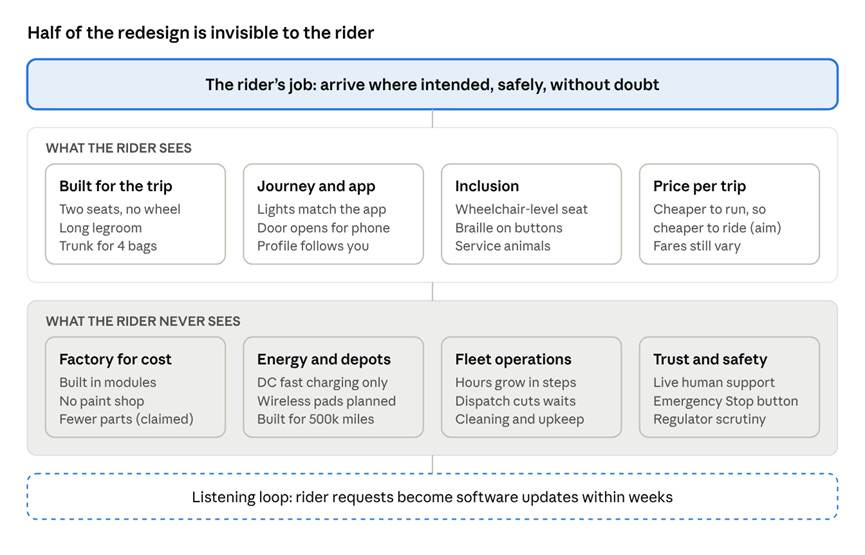
The 360° redesign · half of it is invisible to the rider
But look at the bottom half of that picture. Half the redesign is invisible to the passenger. The factory builds the car in sections and skips the paint shop. It charges at depots. Software decides which car goes where. Teams handle cleaning, repairs and safety. A passenger never sees any of this, yet all of it decides whether the car turns up on time, clean and affordable.
That is the first big lesson. Most companies redesign the half the customer sees and forget the half that keeps the promise.
The ride becomes a room
An old taxi sold one thing: getting you there. The new one is trying to sell a second thing: what you do with the twenty minutes on the way. Tesla’s own report to investors calls the car a place to travel, a place to work and “a second living room”.
Look at what has been added in just the first two months, and you can read the modern customer’s wish list:
• “My time matters.” You can ask the voice assistant to handle emails, your calendar or a coffee order while you ride. • “Keep me entertained and connected.” Streaming, music and games on a big screen, with satellite internet built in. • “Tell me before I ask.” Your phone’s lock screen and watch show how many minutes are left. • “Let my family know I’m safe.” You can share your live trip with someone. • “Let me switch off.” A quiet mode darkens the whole screen for a late-night ride.
Two lessons travel well beyond cars.
First, the time a customer spends with you is part of what you sell. Think of a clinic waiting room, a bank queue, a service-centre lounge or the hour between ordering and delivery. Most businesses treat that time as wasted. The best ones design it.
Second, modern customers want control without effort. Almost every feature above either answers a question before it is asked, or gives the customer a button so they do not have to ask anyone. That is what people now expect everywhere, from their bank to their spare-parts supplier.
The invisible work that keeps the promise
Here is a simple truth about any taxi. A private car can sit in the garage all day and nobody loses money. A taxi that is charging, being cleaned or waiting for a mechanic earns nothing. For a taxi business, every minute off the road is money lost.
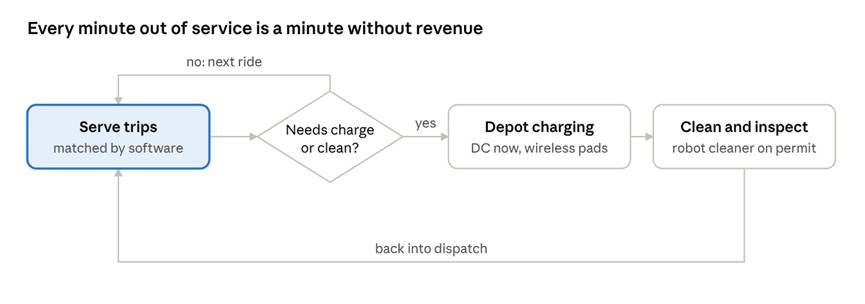
The fleet loop · where downtime hides
With no driver to plug the car in, wipe the seats or report a strange noise, every one of those jobs has to be rethought.
• Charging. The car is unusually frugal with electricity, so it needs fewer stops. It charges at depots, not homes. Planning papers for a new Austin site describe a “robocar carwash and charging” lot with 80 wireless charging pads, so a car can simply park and charge with nobody plugging it in. • Cleaning. Another permit, for Tesla’s Austin taxi hub, lists a cleaning robot and an inspection system. The cabin itself is kept bare, with no glove box and only two seats, which leaves fewer places for mess. • Repairs. Tesla engineers say the car is designed to last 500,000 miles, and that a single faulty battery section can be swapped instead of the whole battery. Fewer parts means fewer things to break. These are claims; time will tell. • Dispatch and help. Software decides which car goes where. If a rider needs help, a real person answers from the screen.
To its credit, Tesla is frank that this side is still being built. Its filings say that, for now, charging, cleaning and repairs run through its existing chargers and service centres, and that dedicated facilities are being developed as the service grows .
The lesson for every business: your customers never see your back office, but it sets the limit on what you can promise them. A clinic can only see as many patients as it can clean instruments for. A factory can only accept small orders if it can switch machines quickly. A hotel can only offer early check-in if housekeeping keeps up.
Small first, then bigger
Most companies launch with a bang. This one launched with a series of small, careful steps, each one turning a single dial:
- Start with a stand-in. In June 2025 the taxi service began in Austin using ordinary Model Y cars, a small area, invited riders only, and a staff member sitting in the front seat. 2. Open the doors slowly. Months later the app was opened to the public. In early 2026 the first rides ran with no employee on board, at first only a few. 3. Prepare each city before arriving. New cities followed: Dallas, Houston, Miami, Orlando and Tampa. Before each launch came testing, permits and training for local police and fire crews. 4. Build the back office early. Charging and cleaning hubs were being planned before the new car carried its first paying passenger. 5. Then bring in the purpose-built product. The Cybercab joined in September 2026, with the app and the car launched together as one experience. 6. Stretch the hours a step at a time. Service ran from 6 am to 9 pm at first, then to midnight, with 2 am next. 7. Use the big moments. On the Formula 1 race weekend in October, more than 50 Cybercabs were on Austin’s streets, in front of huge crowds. 8. Publish your own report card. Tesla now runs a public safety page with a live counter of miles driven, and a guide for emergency crews.
The principle is simple: let the promise grow only as fast as your ability to keep it.
It has not all gone to plan. Tesla’s founder once predicted a million robotaxis on the road by 2020. Several 2026 city launches slipped. And the factory can now build Cybercabs faster than the company can put them to work: about 463 are registered in Texas, while the service still covers parts of one city. Tesla’s own engineering head admits production is “outpacing our deployments”. Making the product is no longer the hard part. Delivering the experience is.
What riders say
The early reviews follow a pattern worth noticing.
They love the middle of the trip. Reviewers describe the drive as smooth and quiet. One rider called it “perfectly boring”, which is exactly what you want from a car with nobody driving. On his ride home, in one of the older driverless Model Y cars, the Austin journalist noticed it leave a gap at a red light so oncoming traffic could turn. He called it courteous.
They complain about the start and the end. A first wait of about 15 minutes. Drop-offs a three-minute walk from the destination, in the rain. A car stopping awkwardly on a narrow road, leaving the passenger embarrassed as other drivers stared .
And when they asked, the company listened. On 9 October a regular rider posted a simple request: with no mirrors and no rear window, could passengers see the rear camera, “especially for peace of mind”? A Tesla engineer replied, “In development.” About two weeks later, it was there. The rider wrote that it was crazy to see it already live.
Here is the lesson hiding in those reviews. Customers rarely judge you by your core product. They judge you by the edges: the wait before, the hand-over after, and what happens when something small goes wrong. The car can drive beautifully and still lose the customer in the last fifty metres. So can an excellent surgeon with a confusing discharge desk, or a well-made machine delivered with nobody to install it.
Everyone else is moving too
It would be easy to assume the most famous company is winning. It is not, at least not yet.
Waymo, owned by Google’s parent, is the quiet leader. It was giving about 500,000 paid rides a week by March 2026 and runs more than 4,000 cars in over a dozen US cities . Its bet is caution: more sensors, more testing, trust first. A week before the Cybercab launch, it publicly argued that cameras alone are not enough.
Baidu, in China, built its own low-cost robotaxi and gave 3.2 million driverless rides in just the first three months of 2026. Zoox, owned by Amazon, built a four-seater where passengers sit facing each other, and waited for federal approval before charging passengers anything .
The most interesting response has come from Uber, the company that last shook up the taxi business. It does not want to build robotaxis. It wants every robotaxi to be bookable on its app. It has signed up more than 30 driverless-car partners and, according to the Financial Times, committed around $10 billion, including at least 35,000 Lucid cars built specially for its future driverless service. Waymo, meanwhile, is pulling away from Uber to build its own direct relationship with riders.
So the industry is splitting three ways. Build everything yourself (Tesla: car, software, app and fleet). Own the technology and the customer (Waymo). Own the marketplace (Uber). Every business in a changing industry eventually has to pick which part it will own: the product, the operation or the customer relationship. The part you neglect is usually the part someone else takes.
And India tells its own story. Rapido grew to nearly half of India’s ride-hailing market by industry estimates, not by redesigning the vehicle but by redesigning the deal. It offered bike taxis for the solo commuter in heavy traffic, and, following Namma Yatri, a flat daily fee for drivers instead of a cut of every fare. Uber and Ola soon offered drivers similar plans. Putting the customer first includes the people who serve your customer.
What is still unproven
An honest story needs its open questions.
• Does it make money? Tesla has not published how many paid rides it gives or how busy each car is. Its founder says the business will not show up in Tesla’s results until mid-2027. • Will the rules allow it? Safety rules were written for cars with steering wheels. US regulators are reviewing whether this one complies, and firefighters in Austin have asked how to deal with a car nobody can drive. • Will people trust it? Every awkward stop shared online costs trust that took months to build. • What about drivers? Millions of people, many of them in India, earn their living driving taxis, autos and ride-hail cars. Driverless taxis will not crowd Indian streets soon, but the direction is clear, and the people who powered the old model deserve a plan.
A brilliant product is where a good business starts. It is not proof that one exists.
Six lessons for every business
Take away the gold paint and the technology, and six lessons remain. None of them needs a robot. All of them need a decision.
1. What you inherited is not what your new customer needs. Your product was probably designed for your first customer. When you sell to a new group, through a new channel or in a new town, ask what you would build if you started from scratch for them. A Rajkot parts maker supplying car companies in big pallets may find that a dealer wants small mixed cartons and a fixed delivery day.
2. When you remove a person, rebuild the kindness they provided. The driver who waved, opened the door and lifted your bag has become a light, a sensor and a screen. Every bank that moved to an app and every clinic that put in a kiosk faces the same test. List what your front-line staff do that is not in any job description. That is your design brief.
3. Loyalty is won at the edges. Riders praised the drive and complained about the pickup and drop-off. Patients remember the discharge, buyers remember the installation, guests remember check-out. Find your “last fifty metres” and give it an owner.
4. The back office decides the front office. A promise made in the showroom is kept or broken in the factory, the warehouse and the delivery van. Before you launch anything, ask the operations team, not just marketing, what could stop you keeping your word.
5. Customers now expect you to listen in weeks, not years. A rider asked for a camera view and had it in about two weeks. People who see that once start expecting it everywhere. Decide which requests you can act on within a month, and tell customers when you do.
6. Your people and partners are customers too. Rapido won India by making the deal better for drivers as well as riders. Your dealers, franchisees, nurses and technicians are customers of your business model. Ask whether they are better off for working with you.
BMCG perspective: In our customer-experience work, we rarely start with the product. We start with the moments when a customer has to wonder: Is this right? Will they turn up? Who do I call? Most owners know their product’s strengths. Far fewer have mapped where their customers feel doubt, or which part of the business creates it.
Where to start on Monday
You do not need Tesla’s money or technology to use any of this. You need to look closely, choose carefully, test small and measure honestly. Five questions will get you going:
- Who is the customer now, and what are they really hiring us to do? Write it in one sentence. 2. What are they paying for that they never use, and what small thing would remove their biggest worry? Keep, cut, add. 3. Where does the customer have to wonder, wait or ask? Walk through it yourself, or watch three real customers do it. 4. Can our operation actually keep this promise, at a price that still makes money? Ask the people who will have to deliver it. 5. What is the smallest test that would prove us right or wrong? One branch, one product, one district, for one quarter. Decide in advance which numbers will tell you.
Then listen to what happens, fix what keeps coming up, and only then grow.
The clever part is the easy part
In our work with family businesses, owner-led companies and leadership teams, we rarely find a shortage of ideas. Most teams can list twenty improvements by lunchtime. The hard part is choosing the two that matter most, testing them sensibly, and making sure someone owns the result once the launch excitement fades.
The taxi story shows why. One of the most inventive companies in the world has redesigned its product brilliantly, and still finds its factory running ahead of its service. The quieter companies leading the field are the ones that built the operations, the trust and the economics to match the promise. A redesign without execution is a beautiful prototype. Execution without a redesign is efficiently going out of date.
That gap between strategy and what happens on the ground is where Blue Mango Consulting Group works, across turnaround, transformation and growth. Often the most useful thing we deliver is not another strategy document but a short list: what to change, in what order, how to test it, and how you will know it worked.
Back to the car park
Remember the journalist dropped outside the wrong restaurant. The car drove him well. The technology worked. But for the last few metres, his experience belonged to nobody.
Every business has its own version of that car park: the place where a good product meets a customer who is left to fend for themselves. The companies that lead the next decade, in transport or healthcare, manufacturing or retail, will be the ones that find that place first.
So here is a question for your next team meeting: which part of your business still exists because it suited your first customer, and is your newest customer quietly paying for it?
If that question is already on your table, a conversation is a good place to start: bluemangoconsultinggroup.com .
Independent analysis based on public sources as of 28 October 2026. Not investment advice; not affiliated with or endorsed by any company mentioned. AI was used as a research and editorial aid; all opinions and conclusions are the author’s own.
Sources
Accessed 28 October 2026, company figures are company claims.