

If Your Business Is Still Running on 2019's Model, Someone Will Take Your Customers
Be it any Industry or Business
**If Your Business Is Still Running on 2019’s Model,**Someone Will Take Your Customers
Oct 21, 2026 · @Kirtiraj
By Kirtiraj Gohil, CMC® | Founder, Blue Mango Consulting Group | bluemangoconsultinggroup.com · bmcg.in
**The biggest changes in business since 2020 did not arrive as headlines. They arrived as quiet currents: in how customers discover, choose and stay loyal to brands, in how products reach them, in what things cost and where they come from. Each looked small when it began. Together they have rewritten the rules for legacy brands and companies, world over and in India. The businesses that lead the next five years will be the ones that see these currents early, test their own assumptions against them, and bring in the right outside expertise before the market forces the question.**And yes No Industry or Business is immune.
In brief
At BMCG we hold a simple view: the volume and variety of change businesses have absorbed in the last six years is closer to what a generation would normally see across twenty years. The visible shocks are well known: a pandemic, generative AI, tariff wars, shipping disruptions and an energy crisis. The more dangerous changes are the soft, invisible ones.
Customers now discover brands on social feeds and ask AI assistants what to buy. Loyalty that took decades to build can be eroded by a cheaper “dupe” in a season. Distribution models that worked for fifty years can be outflanked in eighteen months. Supply chains that ran on cost now run on risk. And new forces, from weight-loss drugs to carbon border taxes, are quietly changing what customers consume and what goods cost to sell.
This article maps six of these currents through stories from around the world, draws out what each means for Indian businesses, examines what rigorous research says about the value of outside expertise, and offers a practical five-year introspection for every owner, promoter and board. Our argument is not that consultants have the answers. It is that no business should be the only one checking its assumptions when the ground beneath it has moved this much.
Twenty years of change in six
Since 2020, the world economy has absorbed at least ten structural shifts, each of which would once have defined a decade. “Twenty years in six” is a judgment, not a statistic, but the record below shows why we hold it.
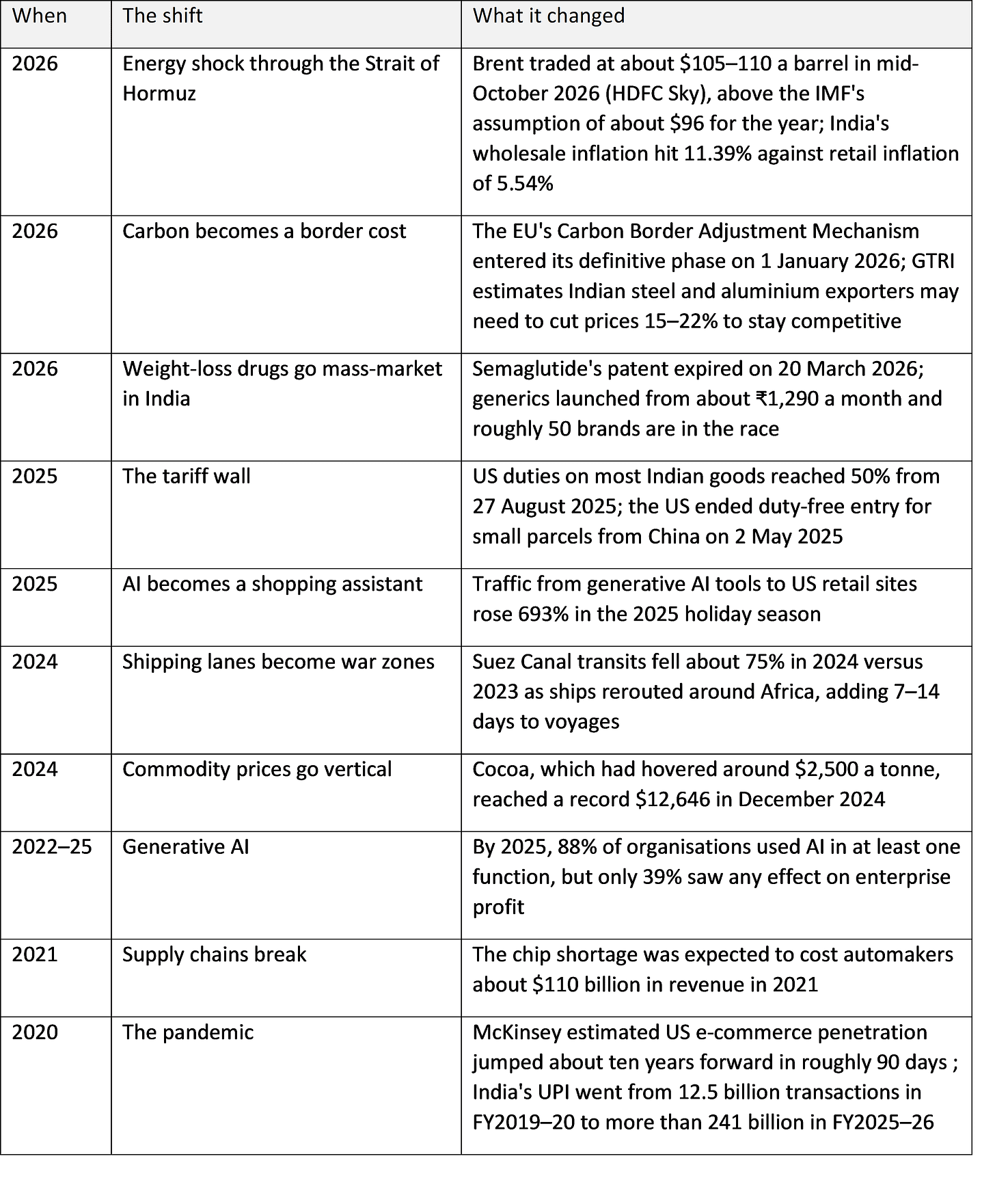
Three properties make this period different
Velocity. Shifts that once played out over a business cycle now play out within a quarter. AI-referred shopping traffic barely existed in mid-2024.
Variety. The shocks come from unrelated directions at once: health, technology, trade policy, war, climate and regulation. A business can be ready for one and blindsided by the next.
Simultaneity. The shifts compound. An Indian exporter in 2026 faces a tariff reset, carbon border costs, freight and energy spikes and cheaper competition, all in the same planning year.
The headline shocks are only half the story. Beneath them run six quieter currents that are reshaping how businesses win and lose customers. Each began as a niche behaviour. Each is now going mainstream.
Current 1: Business models are being rewritten, and profit pools are moving
The most consequential changes since 2020 are not new products. They are new ways of making money from the same customers, which quietly move profit away from companies that keep doing what they always did.
Shein and Temu: the model that inverted inventory risk, and the loophole that undid it
Traditional fashion retail commits to large production runs months ahead and hopes demand arrives. Shein inverted that. New styles typically launch in batches of around 100–200 pieces; data on what sells decides what gets scale. Combined with factory-direct shipping of small parcels that entered the US duty-free, the model undercut legacy retailers. When Forever 21 filed for bankruptcy in 2025, it blamed Shein and Temu’s use of that duty exemption for undercutting its business (same source).
Then geopolitics changed the rules. After the US ended the exemption for Chinese parcels on 2 May 2025, Temu’s average US app ranking fell to 132 in May from the top three a year earlier, and its US ad spend fell 95% . Both companies began rebuilding around local warehouses.
The lesson cuts both ways. A data-driven, test-and-repeat model can beat decades of scale. But a model that depends on one regulatory advantage is one policy change away from repricing.
Retail media: when the shop becomes a media company
The world’s largest retailers have discovered that their most profitable product is not what they sell but access to their shoppers. Amazon’s advertising revenue reached $19.8 billion in a single recent quarter, up from $15.7 billion a year earlier, and Walmart’s advertising arm grew about 43% . One investment-bank analysis estimates advertising margins of 70–90% against low single-digit retail margins, and that advertising contributed roughly a third of Walmart’s profit by the end of 2024 while being under 1% of sales ; treat that as an estimate rather than a disclosed figure.
The same shift is visible in India, where brands increasingly pay quick-commerce and marketplace platforms for visibility on the digital shelf. For a brand owner, the cost of reaching the customer is migrating from distributor margin to platform advertising.
What this means for an Indian business
Ask where the profit pool in your value chain is moving. In many categories it is shifting from making the product to owning the customer data, the shelf (physical or digital) or the speed of response. A manufacturer can borrow the small-batch logic by testing new SKUs in limited runs before committing capacity. A distributor can ask whether the data it holds about retailers and end-customers is worth more than the margin it earns on boxes.
Current 2: The customer journey has been rewired, from discovery to loyalty
The classic funnel assumed customers became aware of a brand through advertising, considered a few options, bought, and then stayed loyal out of habit. Every stage of that journey has changed.
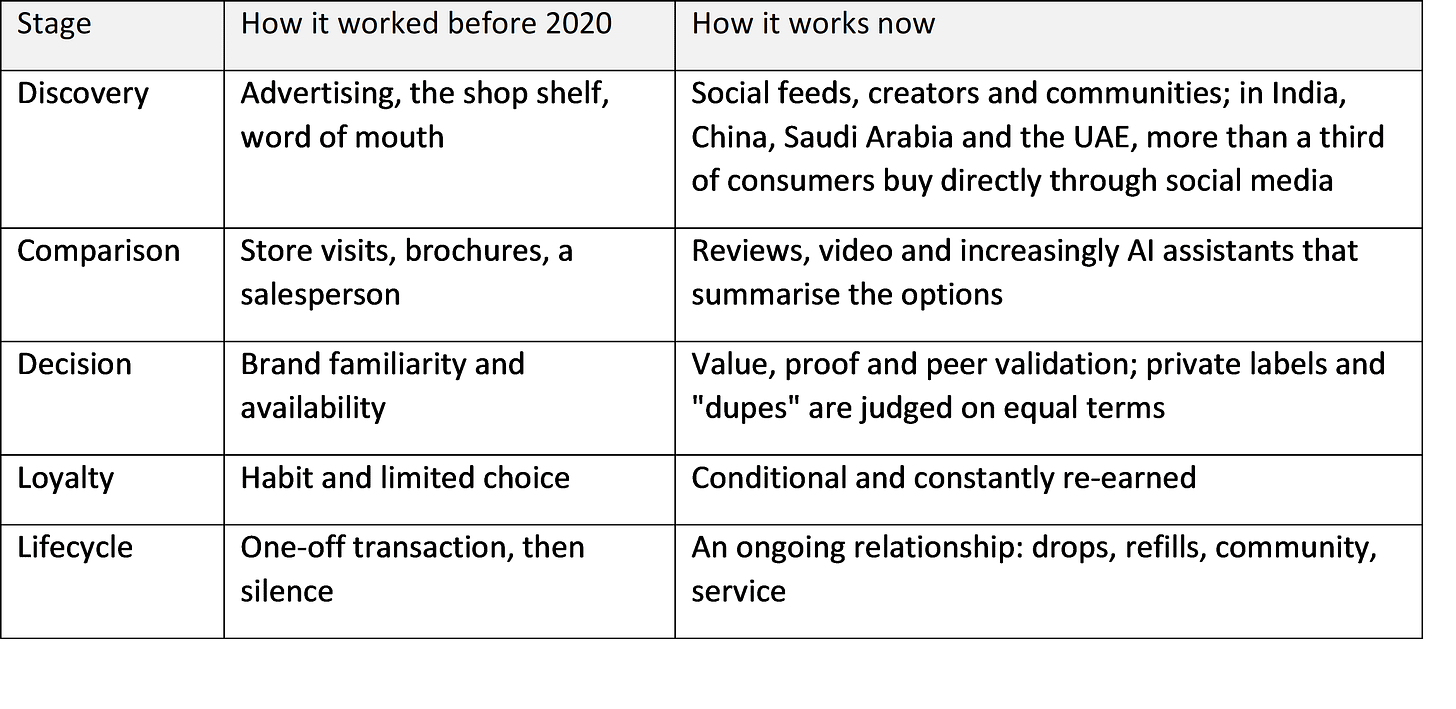
Stanley: a 110-year-old brand reborn by three bloggers
For most of its history, Stanley sold rugged green flasks to working men. Its Quencher tumbler launched quietly in 2016 and went nowhere through traditional channels. Then three women running a shopping blog called The Buy Guide began recommending it to their followers and placed a bulk order for 5,000 cups themselves. A new president, who had helped revive Crocs, recognised the signal, partnered with them on new colours and rebuilt the brand around women and collectable limited releases. Stanley’s revenue rose from $73 million in 2019 to a projected $750 million in 2023.
The product barely changed. What changed was who the customer was, where she discovered the product and why she came back for another one. The signal came from outside the company, from a customer community it had never targeted. Stanley’s advantage was not that it planned the trend, but that it listened and acted fast.
The AI shopper has arrived
In the 2025 US holiday season, traffic to retail websites from generative AI tools rose 693% year on year. Shoppers arriving from AI assistants were 33% less likely to leave immediately, and 65% of consumers using AI for shopping said it made them more confident in their purchase. The base is still small, but the direction is clear. When a customer asks an AI “which is the best option for me?”, the brand that wins is the one the AI can understand, verify and recommend, not necessarily the one with the biggest advertising budget.
Loyalty has become conditional
McKinsey’s survey of 15,000 consumers in 18 markets found that over a third had tried a different brand in the previous three months, and about 40% had switched retailers in search of better prices. Sixty percent believed private-label products were as good as or better than national brands, and older consumers, once the most loyal, were switching too .
What this means for an Indian business
A legacy brand’s greatest asset, familiarity, is worth less when customers discover through creators, compare through AI and treat a retailer’s own label as equal. Three questions matter: do we know where our next generation of customers first hears about us; can an AI assistant find clear, verifiable reasons to recommend us; and what do we do for a customer after the first sale that makes the second one more likely?
Current 3: Distribution is being reinvented, and the answer depends on the market
How a product reaches the customer used to be the most stable part of a business. Since 2020 it has become one of the most volatile, and the costliest mistakes have come from treating a temporary channel shift as permanent, or from copying a model that works elsewhere.
Nike: the world’s strongest brand misread its channels
From about 2020 to 2023, Nike pushed hard to sell directly to consumers through its own app, website and stores. It cut ties with long-standing retail partners, from department stores to Zappos, to capture more margin and own the customer relationship. The logic was sound and the early pandemic results looked good. But when shoppers returned to stores, the shelf space Nike had abandoned went to competitors, especially the running upstarts On and Hoka, and Nike’s own digital channel leaned on discounting that taught customers to wait for markdowns.
Nike brought back a retired 32-year veteran, Elliott Hill, as CEO in October 2024. His “Win Now” plan reversed much of the strategy. Wholesale is roughly 60% of revenue again, and North American wholesale grew about 20% in a recent quarter, while Nike Direct fell 4% and digital fell 9% in another.
The lesson: customers do not belong to channels; they move between them. A distribution decision made on the evidence of one unusual year can cost a market leader several years to undo.
Quick commerce: a failure in Europe, a boom in India
Turkey’s Getir raised money at an $11.8 billion valuation in March 2022, bought Germany’s Gorillas and built Europe’s biggest network of ten-minute grocery stores. By April 2024 it had exited the UK, Germany, the Netherlands and the US entirely . One European competitor’s CEO argued that quick commerce only works profitably where labour is abundant and affordable.
In India, the same model is thriving. The dark-store networks of Blinkit, Instamart and Zepto grew from 3,405 to 5,026 in the year to May 2026, and the segment is projected to reach about ₹1.08 lakh crore in 2026, growing roughly 40%. Dense cities, affordable delivery labour and instant UPI payments make the economics work here in ways they did not in Berlin or London.
What this means for an Indian business
Two lessons follow. First, a channel strategy should be tested against what customers do over several years, not one exceptional season. Second, global models must be re-run on Indian economics, and Indian models on export-market economics, before capital is committed. For an FMCG or consumer-durables company, the questions are concrete: what share of our category now sells through quick commerce and marketplaces, what does each channel really cost us after platform fees and advertising, and how dependent are we on distributors whose own future is being reshaped?
Current 4: Technology is changing both the customer and the company
Technology since 2020 has worked on two fronts at once. It has changed what customers expect and can do for themselves, and it has changed how companies operate. The two stories below show the danger on each front: being replaced by technology, and replacing people with technology too quickly.
Chegg: the first company publicly undone by generative AI
Chegg sold homework help to students for about $15–20 a month and boomed during pandemic remote learning, reaching a market value of about $14.5 billion. In May 2023, its chief executive told investors that students’ interest in ChatGPT was hurting new customer growth; the stock fell about 48% the next day. Google’s AI-generated answers at the top of search results then cut off much of the traffic that had brought students to Chegg in the first place.
Revenue fell from $618 million in 2024 to $377 million in 2025, the company cut more than half its workforce across two rounds of layoffs, and the stock fell more than 99% from its 2021 peak . In Chegg’s 2022 annual report, AI was not mentioned once.
The lesson: any business whose core value is information, answers or simple intermediation should assume that AI will offer a free or near-free version of it. The question is what you provide that an AI cannot: accountability, a relationship, a physical service or judgment applied to a specific situation.
Klarna: the AI-first pivot that had to bring humans back
In February 2024, Swedish payments company Klarna announced that its AI assistant had taken on about 75% of customer service chats, some 2.3 million conversations in its first month, and was doing the work of about 700 agents. The company froze hiring and let its workforce shrink.
By May 2025, its chief executive told Bloomberg that the focus on cost had led to lower quality, and that investing in the quality of human support was “the way of the future for us”. Klarna began hiring human agents again (same source).
The lesson: AI can cut cost quickly, but customer experience is where cost-cutting is most visible to customers. The winning design is usually AI for speed and scale, with people where judgment, empathy and trust matter.
What this means for an Indian business
Indian businesses face both edges at once. Coaching institutes, information services, agencies, distributors and many professional services sell exactly what AI is learning to provide. At the same time, the pressure to automate customer service, sales and back-office work is rising. The right response is neither panic nor denial. It is a function-by-function review of where AI will commoditise your offer, where it can lower your costs without hurting customers, and where human judgment remains your advantage.
Current 5: Resources, geopolitics and freight have broken the old cost model
For thirty years, most businesses-built cost models on an unspoken assumption: inputs would be available, freight would be cheap and predictable, and prices would move a few percent a year. Since 2020, that assumption has failed repeatedly. Costs now move in multiples, in both directions, and often for reasons that have nothing to do with the industry itself.
Freight: when a shipping lane becomes a war zone
When attacks on ships in the Red Sea began in late 2023, carriers rerouted around Africa. Suez Canal transits fell about 75% in 2024 compared with 2023, and voyages that used the canal took 7–14 days longer. Drewry’s spot rate for a 40-foot container from Shanghai to Rotterdam jumped 164% in a matter of weeks, from $1,667 to $4,406. In 2026, the disruption moved to the Strait of Hormuz and from freight into fuel itself.
Cocoa: a fivefold swing in a core input
Cocoa had hovered around $2,500 a tonne for years. Supply problems in Ghana and Ivory Coast, which grow roughly 60% of the world’s supply, pushed it to a record $12,646 a tonne in December 2024. Large chocolate makers were cushioned at first by long-term hedging contracts, but eventually Hershey announced double-digit price increases and smaller pack sizes. By early 2026, cocoa had fallen back to around $3,700, yet chocolate prices on shelves were still rising as companies worked through expensive stock.
Toyota: the company that prepared a decade earlier
The 2021 chip shortage was expected to cost automakers about $110 billion in revenue. Toyota, the inventor of lean just-in-time production, was among the least affected in the early months. After the 2011 earthquake and tsunami, it had mapped about 1,500 parts at risk, built an early-warning system reaching deep into its supplier tiers and required suppliers to hold two to six months of chip inventory. Toyota was not immune, and it did cut some output later in 2021. But it had paid for resilience in calm years, when it looked like an unnecessary cost.
Closer to home: Morbi in 2026
When the Strait of Hormuz was disrupted in early 2026, Gujarat’s Morbi ceramic cluster lost access to Gulf propane and LNG. By 31 March only 83 of roughly 800 units were operating. ICRA noted that large producers with contracted gas, pricing power, inventory and liquidity were better placed than smaller units buying spot fuel. It was the Toyota lesson, playing out about an hour’s drive from Rajkot.
What this means for an Indian business
A single-number budget is no longer a plan. Every business above a modest size should know how its margins behave if its main input doubles, its freight rises 150%, or a key supplier disappears for three months, and should decide in advance what it would do in each case. Resilience costs money in good years. The businesses that refuse to pay for it are usually the ones that pay most when the shock arrives.
Current 6: The soft currents about to become mainstream
The most dangerous changes are the ones that look marginal today: a medical treatment, a compliance rule, a shift in what a generation values. They rarely appear in industry reports until they are already reshaping demand. Three deserve every board’s attention now.
Appetite itself is changing: GLP-1 drugs
Weight-loss drugs such as Ozempic and Wegovy began as a medical story. They are becoming a consumer story. A Cornell University study of purchase data from a panel of about 150,000 US households found that, within six months of someone starting a GLP-1 medication, household grocery spending fell by an average of 5.3%, spending on savory snacks by about 10%, and spending at fast-food chains and coffee shops by about 8%.
This is no longer a distant American trend. Semaglutide’s patent expired in India on 20 March 2026. Generic versions launched from about ₹1,290 a month, against roughly ₹8,800–10,000 a month for the original brands, and around 50 brands are in the race. India has one of the world’s largest diabetes burdens. Snacks, confectionery, sweets, quick-service restaurants and even portion sizes in packaged food could feel this within a few years. Nobody can yet say how large the effect will be in India, but that uncertainty is exactly why it belongs in a five-year plan.
Carbon is becoming a cost line
For years, sustainability was treated as a reputation issue. Since 1 January 2026, it has been a price issue for Indian exporters to Europe. Under the EU’s Carbon Border Adjustment Mechanism, importers of steel, aluminium, cement, fertilisers and other goods must account for the carbon embedded in what they buy. Iron and steel made up 78% of India’s CBAM-covered exports to the EU in 2023, worth over €5 billion. GTRI estimates exporters may need to cut prices by 15–22% to keep EU buyers, and expects CBAM clauses on cost pass-through and verification to become standard in contracts.
The current will not stop at large steelmakers. Smaller suppliers that cannot provide verified emissions data for their products may simply be dropped from export supply chains.
Values, wellness and proof
McKinsey found that consumers in emerging markets such as India, China and the Middle East planned to increase spending on wellness two to three times more often than consumers in markets like the US and Canada. Combined with conditional loyalty and AI-assisted comparison, this points to customers who expect brands to prove their claims, about health, ingredients, origin or impact, rather than simply assert them.
What this means for an Indian business
Soft currents become hard numbers slowly, then suddenly. The practical step is to keep a short “weak signals” list, review it every quarter, and ask of each item: if this became mainstream in three years, which of our products, customers or markets would it hit first, and what would we need to have started today?
What the six currents mean for legacy brands and companies
Legacy businesses are rarely beaten by one dramatic event. They are worn down by several quiet currents at once, each of which looked too small to act on. The map below summarises what each current breaks and the early signal to watch for.
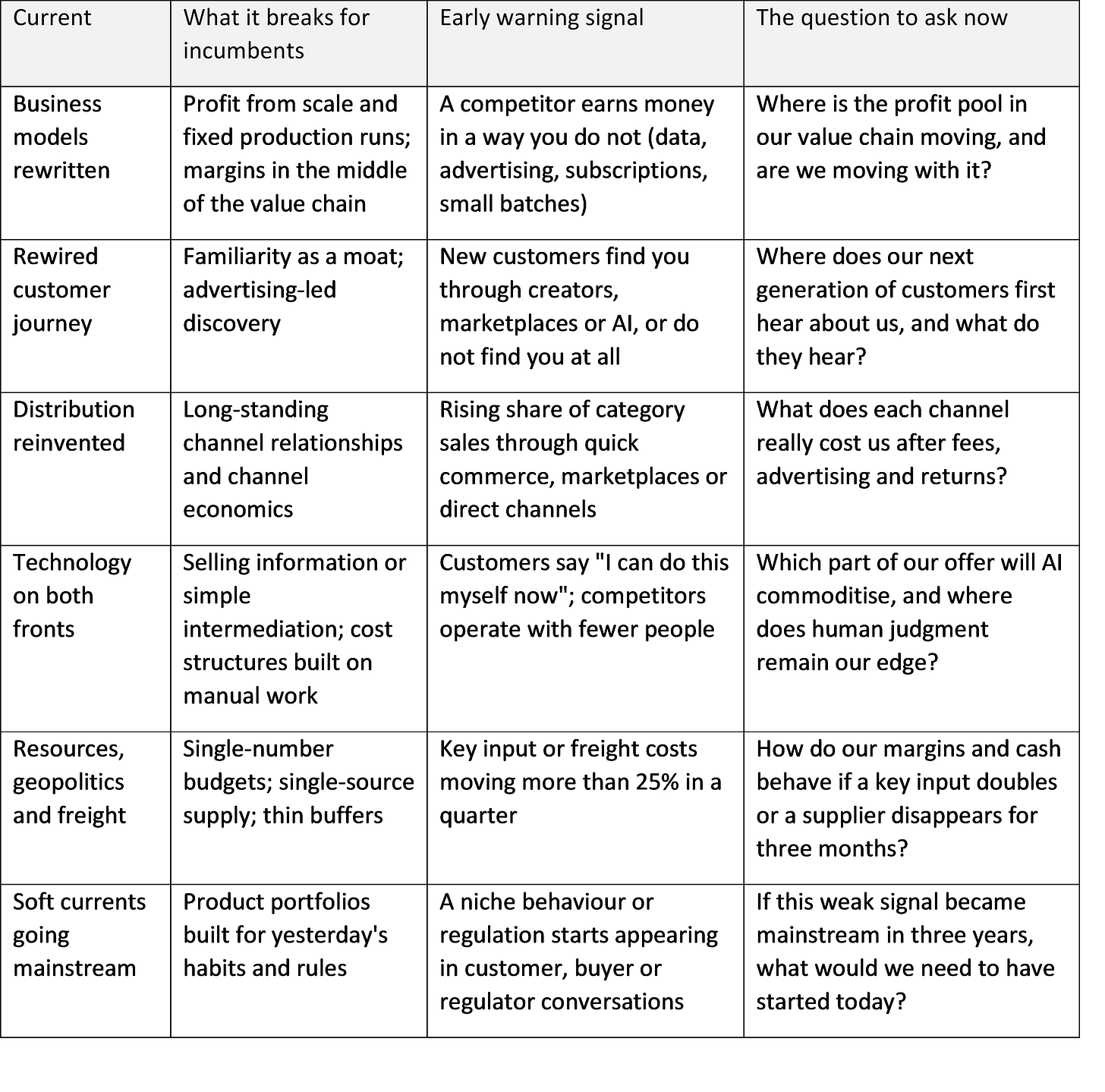
No single row is fatal on its own. The risk lies in the combination, and in the fact that insiders, focused on running today’s business, are often the last to see it.
Why good businesses keep running on old maps
Nike, Chegg and Getir were not run by careless people. Each had capable leaders, strong investors and abundant data. Most owner-led businesses we meet are no different: they lack not intelligence or effort, but an outside vantage point at the moment they need it most. Five patterns recur.
1. The success trap. The playbook that built the business is the hardest one to question. Past success proves the old assumptions worked, not that they still hold.
2. Mistaking a spike for a trend, or waiting for normal. Getir and many pandemic winners scaled as if 2021’s demand were permanent. Others make the opposite error and wait for rates, oil or demand to “settle back”. Both are untested bets about the future.
3. The mirror problem. The founder, the family, the senior team and the long-standing CA see the business from the same angle. They are valuable precisely because they know it well, and limited for the same reason.
4. No bandwidth to step back. The owner is also the head of sales, the chief negotiator and the last word on credit. A landmark study of Indian firms found that limits on owners’ time, and not knowing what better practice looked like, were the main reasons profitable improvements were never adopted.
5. Advice from people with a stake. Investors, lenders, suppliers, platforms and software vendors all give advice, and each has an interest in the answer. Advice is plentiful. Independent advice is rare.
How owners are trying to cope today
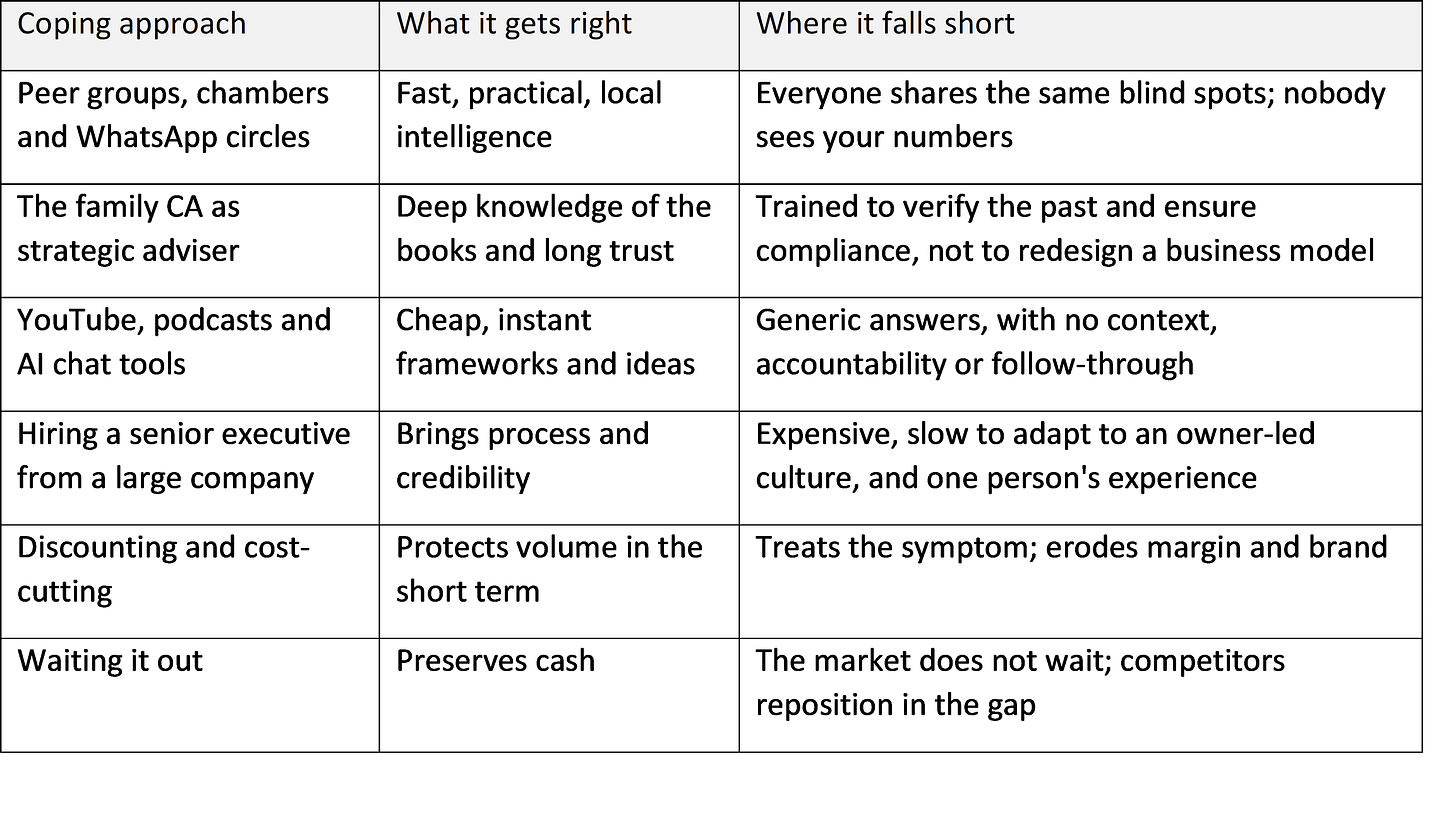
None of these is wrong. Each is incomplete. What is usually missing is an independent, structured and accountable look at the whole business: its economics, its customers, its people and its next five years.
What the evidence says about outside help
The strongest evidence that structured outside help improves business performance comes from randomised trials, the method used to test medicines. Two stand out.
India, large textile firms. Researchers from Stanford, the World Bank and other institutions provided free management consulting to randomly chosen plants of Indian textile firms and compared them with similar plants that received none. Productivity rose 17% in the first year through better quality, efficiency and lower inventory, and within three years the treated firms had opened more plants. The main reason these profitable firms had not made the changes themselves was information: owners did not know what better practice looked like or what it would deliver.
Mexico, 432 small and medium enterprises. A one-year consulting programme raised productivity and return on assets. Five years later, treated firms had about 50% more employees and a correspondingly larger wage bill. The largest gains came from marketing, financial accounting and long-term planning.
The honest counterpoint
The Indian researchers returned eight years later. About half of the practices introduced had been dropped, although treated plants still outperformed the others. The most cited reasons were a new plant manager arriving and a lack of director time.
Advice without embedded execution decays. Change survives when it is built into roles, routines and reviews that outlast the people who started it, and when the owner stays involved. These programmes were also intensive and well designed; a weak consultant will not reproduce their results, and no study can predict what one engagement will deliver for your business. What the evidence does show is that the gap between how a business is run and how it could be run is real, measurable and often invisible from the inside.
AI can draft a strategy. It cannot own the last mile.
Any owner can now ask an AI tool for a five-year strategy and get a competent-looking document in seconds. We use AI ourselves for research and analysis, and encourage clients to do the same. But the strategy document was never the scarce part.
In McKinsey’s 2025 global survey, 88% of organisations used AI in at least one function, yet only 39% could attribute any effect on enterprise profit to it, and only about 6% qualified as high performers. What set those high performers apart was not better prompts: they redesigned workflows, scaled faster and invested in making change stick . Klarna’s experience points the same way: the technology delivered the cost saving quickly; the judgment about where it hurt customers came later, and from people.
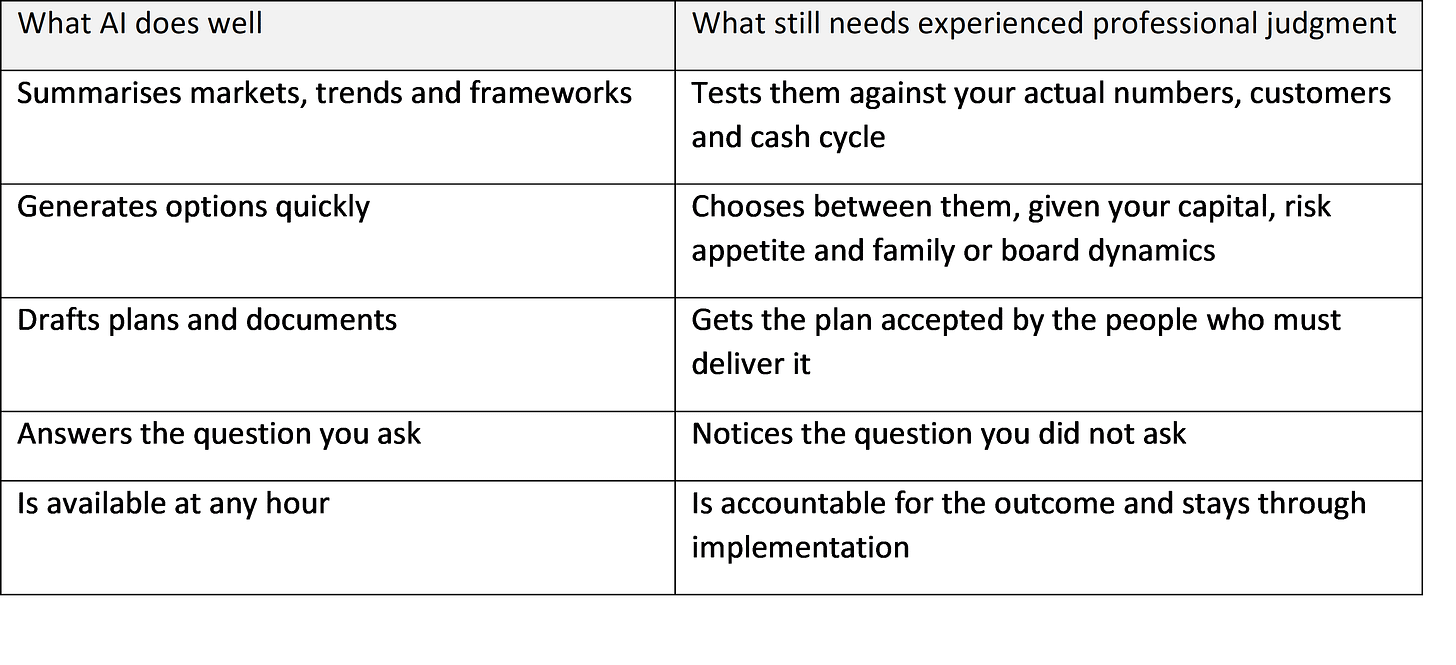
The real choice is not between AI and consultants. It is between a generic answer and one customised to your business in its current form, challenged by someone independent and carried through to the last mile on the ground.
The second-opinion principle
If someone in your family were unwell and not improving despite the family doctor’s treatment, you would seek a second opinion from the best specialist you could find. You would not see it as a judgment on the family doctor. You would see it as responsible care.
The medical evidence supports that instinct. A Mayo Clinic study of 286 patients referred by primary care for a second opinion found the original diagnosis was confirmed in only 12% of cases. In 66% it was refined, and in 21% it was distinctly different . These were complex cases referred precisely because doubt existed, so the figures do not apply to every illness. That is the point: when the situation is complex and the stakes are high, a fresh expert view changes the answer more often than we expect.
Business already accepts this principle for the past. Every company submits its accounts to a statutory audit, because no one should be the only check on their own numbers. Listed companies appoint independent directors for the same reason. Yet very few businesses ask anyone independent to examine the assumptions their future depends on: who the customer will be, how they will discover and buy, what the business will cost to run, and where the next competitor will come from.
A second opinion on strategy is not a vote of no confidence in the founder, the family or the CA. Like the specialist in medicine, it works best alongside them. The CA knows the books. The family knows the history. An independent consultant brings structured diagnosis, cross-industry and cross-border patterns, and the freedom to say what insiders cannot.
Why the standard matters: high-calibre consulting is no longer reserved for large companies
For decades, rigorous management consulting in India was effectively reserved for listed companies and multinationals with large budgets. The disciplines those firms rely on, however, are not proprietary: hypothesis-driven problem solving, evidence before opinion, structured diagnostics, scenario planning, independence and a code of conduct. What a large firm’s fee also pays for is its brand, its overhead and its leverage model. An owner-led business with ₹5 crore to ₹500 crore of turnover deserves the same quality of thinking, sized and priced to its reality.
The difficulty for a buyer is telling good consultants from bad ones before hiring. Anyone can print “consultant” on a visiting card. This is where professional certification matters.
What the CMC® designation signals
The Certified Management Consultant (CMC®) is the international professional designation for management consultants, awarded through national institutes of the International Council of Management Consulting Institutes (CMC-Global) in more than 49 countries to common standards. In India, the awarding body is the Institute of Management Consultants of India (IMCI), a full ICMCI member since 1989.
A CMC must demonstrate competence across a professional body of knowledge, pass an assessment that typically includes a panel interview by senior certified consultants, and commit to a code of professional conduct covering legal, social and ethical obligations to clients. ICMCI’s code was among the first international codes of conduct for any profession.
Certification is not a guarantee of results. It is a guarantee of standards: competence, independence, confidentiality and ethical conduct that a professional body can hold to account. For a buyer who cannot easily judge quality in advance, that matters.
Six questions to ask any consultant, including us
- Are you certified by a recognised professional body, and which code of conduct binds you? 2. Do you have any financial interest in the solutions you will recommend, such as commissions from software, lenders or vendors? 3. How will you test our current assumptions with evidence, not opinion? 4. What will you deliver in the first 30 days, and how will we measure it? 5. Will you stay through implementation, and who on our side will own each change after you leave? 6. Can you show us comparable work, with the client’s permission, including what did not go to plan?
Who wins in the age of collaboration
The era of the lone, all-knowing founder is ending, not because founders have become less capable but because the problems have become wider than any one person’s field of view. The people most owners look up to, socially or in business, are in the same boat. The difference is that the leaders among them have built a bench around them.
From the stories in this article, the winners of the next five years will share six habits.
1. They prepare in calm years. Toyota built its chip buffers a decade before it needed them. The Morbi producers with contracted gas made that decision long before March 2026. Help sought before a decision is cheap; help sought after a failure is expensive and often too late.
2. They listen outside their walls. Stanley’s revival came from a customer community it had never targeted. The most valuable signals usually come from customers, channels and markets the business is not yet serving.
3. They orchestrate a bench of specialists. A CA for compliance and tax, a lawyer for contracts, a banker for capital, a technology partner for systems, and an independent consultant for strategy and execution. The owner’s job shifts from doing everything to integrating the best thinking available.
4. They collaborate horizontally, even with competitors. In October 2026, India’s rice exporters’ federation pooled members’ volumes into a bulk shipment of basmati to Iraq and says freight fell from about $350 a tonne by container to about $90 by bulk carrier. These are the federation’s own figures, but the principle travels: clusters can buy freight, power or raw materials as a group.
5. They balance technology with judgment. Klarna showed the cost of automating faster than customers could accept. The winners use AI for speed and scale and keep people where trust is earned.
6. They correct course quickly, and institutionalise what works. Nike’s reversal shows that even giants recover when they admit a mistake and bring in the right expertise. The eight-year Indian study shows that change lasts only when it is built into roles, routines and governance, not into one person.
The businesses most at risk are the mirror image: those waiting for certainty before acting, confusing activity with strategy, and taking advice only from people with a stake in the answer.
The five-year introspection
Every business, whatever its size, should be able to answer three questions in writing: where are we really today, where do we intend to be in five years, and which changes in business models, customer behaviour, technology, resources and regulation could stop us from getting there? The table below turns those into questions an owner, family council or board can work through.
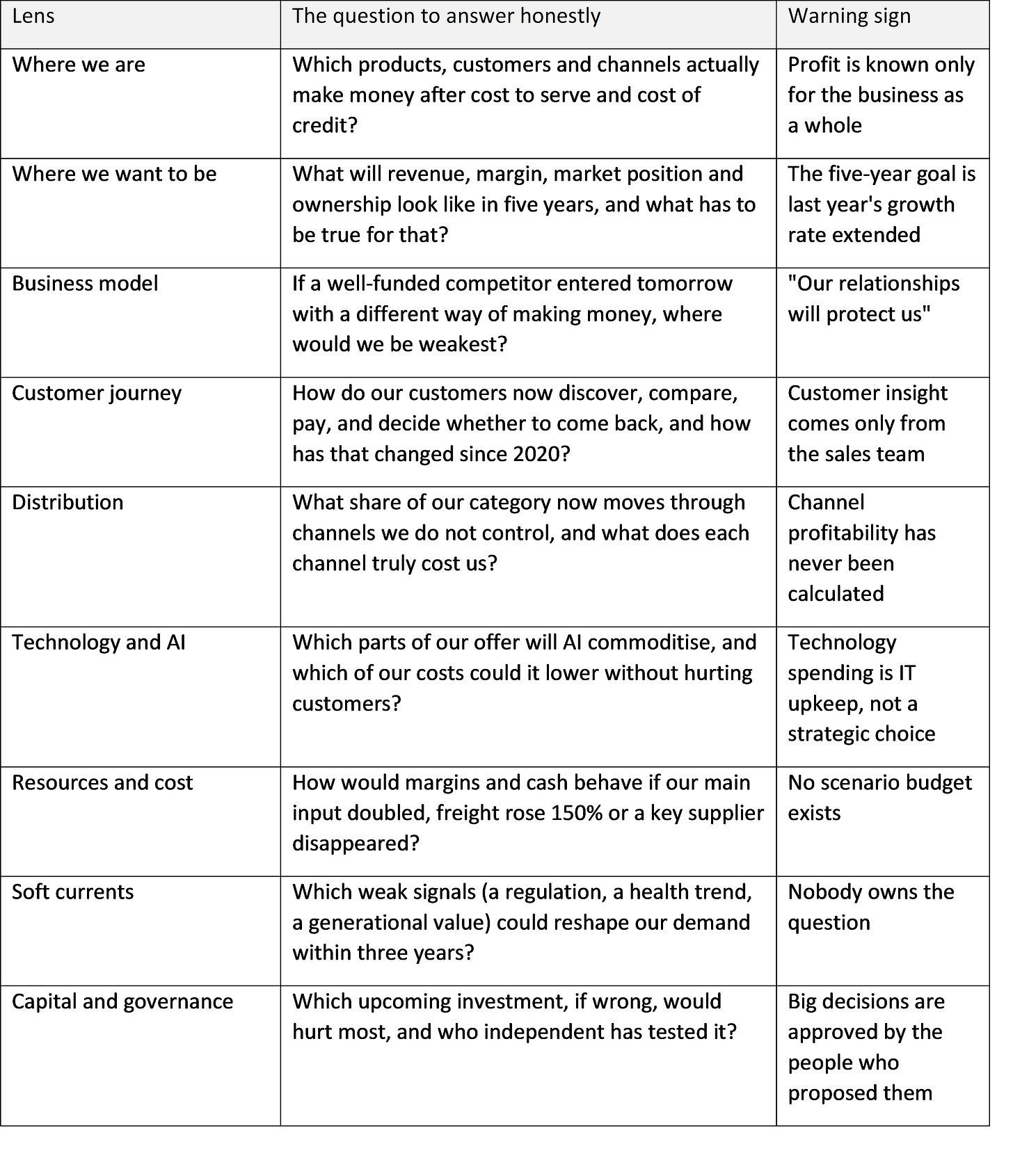
Most owners can answer some of these. Very few can answer all of them with evidence. The gaps are where the risk lies.
The ₹5 crore threshold
We recommend a simple rule. If you are planning to invest ₹5 crore or more in a new business, product, plant, market or acquisition, or if your turnover already exceeds ₹5 crore, seek independent external validation of your plan before you commit.
The reasoning is proportionality. At that scale, a mistaken assumption about demand, pricing, channel, cost or execution can consume years of profit. The cost of a structured independent review is small relative to the capital at risk. The cost of an untested hypothesis can be the whole investment.
External validation does not mean handing over control. It means stating your hypothesis about the future of your business clearly, then asking a qualified, independent professional to test it against evidence and help you either strengthen it or change course while change is still cheap.
Key takeaways
- The ground has shifted, mostly beneath the surface. The headline shocks are visible. The soft currents beneath them, in business models, customer behaviour, distribution, technology, resources and regulation, are what wear down legacy businesses. 2. Profit pools are moving. Shein’s small batches and retail media show money migrating to whoever owns the data, the shelf or the speed of response. 3. Customers discover through creators and AI, and loyalty must be re-earned. Stanley grew roughly tenfold by listening to a customer community it had ignored; over a third of consumers now try new brands every quarter. 4. Channels are not permanent, and models do not travel unchanged. Nike misread its channels; quick commerce failed in Europe and thrives in India. 5. Technology cuts both ways. Chegg was undone by AI as a substitute; Klarna learned that automating customer experience too far costs trust. 6. Cost models now need scenarios, not single numbers. Freight, cocoa, chips and fuel have all moved in multiples since 2020. Toyota and Morbi’s best-prepared producers show that resilience is bought in calm years. 7. Watch the weak signals. GLP-1 drugs and carbon border taxes are already changing demand and export costs, including in India. 8. Outside help works when it is rigorous and embedded. Randomised trials in India and Mexico show large, lasting gains, and show that advice without execution decays. 9. Get a second opinion on your future, not only an audit of your past, and choose advisers by standards, not claims. 10. Use the ₹5 crore rule. Investing ₹5 crore or more, or already above ₹5 crore in turnover? Validate your hypothesis independently before you commit.
About Blue Mango Consulting Group
Blue Mango Consulting Group (BMCG) is an IMCI-accredited management consultancy led by Kirtiraj Gohil, CMC®. We work with owner-led SMEs and MSMEs, family businesses, professional practices, startups and listed companies from Rajkot, Ahmedabad and Mumbai, with engagements across the UAE, UK, Australia, New Zealand and Indonesia.
We invest continuously in research and analysis, including a weekly intelligence brief on the economy, markets and the currents described here, so that our clients see change early. Our STRATEX360™ approach carries strategy through to execution on the ground, because a plan is only worth what it delivers. Our standard is simple: judge us by your numbers, not our invoice.
Start with a diagnosis, not a commitment. Book a free 25-minute Strategic Diagnostic to test where your business stands against these currents and what the next five years could require.
• Website: bluemangoconsultinggroup.com · bmcg.in • Book a diagnostic: calendly.com/kirtirajgohil • Email: care@bluemangoconsultinggroup.com · Phone: +91 98250 00431
This article is for general guidance and is not investment, legal, medical or tax advice. Figures are taken from the public sources listed below as of 21 October 2026; estimates from analysts, industry bodies and think tanks are identified as such. AI was used as a research and editorial aid. All opinions and conclusions are the author’s own.